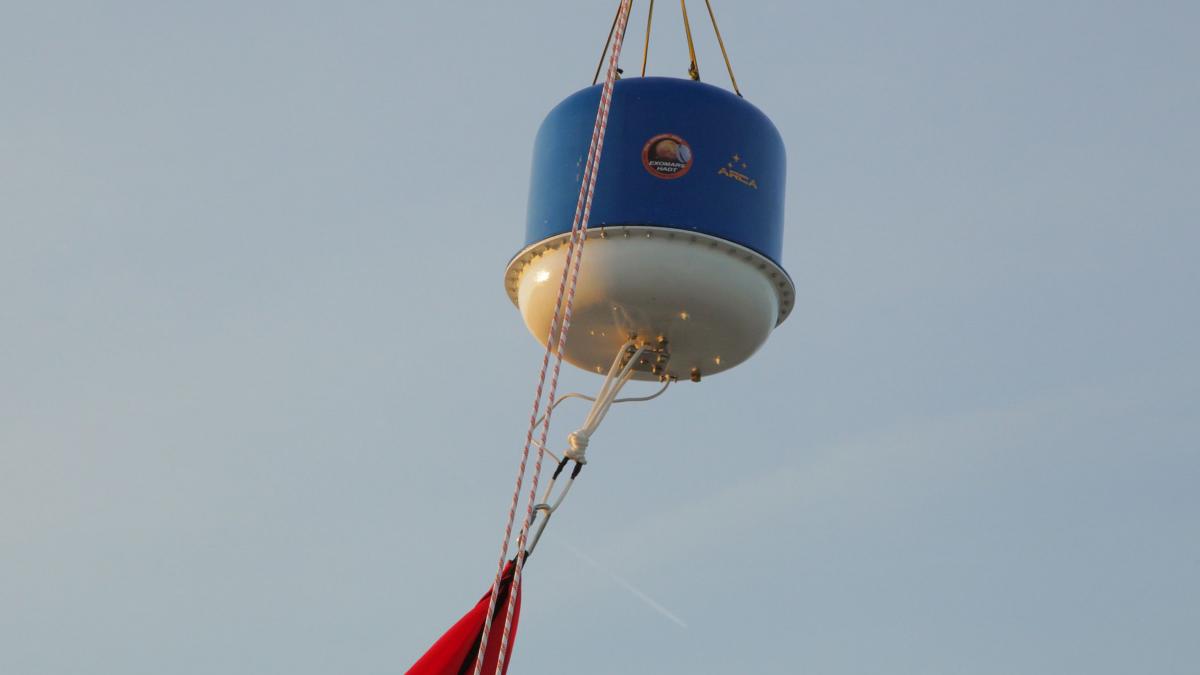

The launch took place from the Black Sea coast and comprised three pressurized containers containing the avionics equipment that will be necessary to test the ExoMars spacecraft parachute during the incoming future flights that will be performed by ARCA. The objectives were flight testing the avionics and communication systems, demonstrating the containers sealing after sea landing and the capability to identify and recover the equipment from the sea surface.
The pressurized containers, carried by the cluster balloon, were launched at 7:15 AM and the ascension took 90 minutes to an altitude of 24,4 km. At this altitude the containers were released under a dedicated recovery parachute and landed on the sea, twenty minutes later. The containers and the recovery parachute were recovered by the Navy, at a distance of 92 km from the launch point.
"The objectives of this mission were carried out successfully and we have great confidence that the next two flights in the ExoMars HADT Program will have the same result. ARCA’s cooperation with the European Space Agency, Air Force and Romanian Air Traffic Services Administration (ROMATSA) for this flight was excellent.", said Dumitru Popescu, ARCA President.
The next ARCA missions from the ExoMars program will consist in testing the parachutes that will allow safe landing of the ExoMars spacecraft on the Mars planet surface, in 2016. For this purpose, two Drop Test Vehicles (DTV), having a weight of over half a ton each, will be launched. At the altitude of around 30 km, these will detach from the carrier balloons and will descend until they will reach the speed of Mach 0,7. At this transonic speed the DTV will deploy the parachutes in order to test them in simulated atmospheric conditions of the planet Mars. The flight parameters will be transmitted from the DTV to the ARCA’s Flight Command and Control Center.
About ARCA
ARCA is a nonprofit organization whose objective is the exploration and colonization of outer space.
In order to reach this objective, ARCA is working to the development of cost effective space vehicles. We are using technologies already existent, in an innovative way, that allow access to space on a large scale by reducing financial constraints. In 10 years of activity, ARCA gained an unique experience, using the lowest budgets compared to its aerospace achievements.
Alongside we have the capability to mobilize hundreds of people from different institutions, civilian and military and to coordinate them in order to reach the objectives proposed by ARCA.
In order to facilitate access to outer space, we have created a family of orbital rockets and suborbital aircraft, using inexpensive, safe and accessible technologies.
The central element in reaching these objectives is the Executor rocket engine series, first engine having a traction-weight ratio of 110, being the third engine in the world from this point of view. In the same time it is the most inexpensive first stage rocket engine ever developed for an orbital launcher.
Another element that contributes to the reduced cost of the rockets are the composite materials fuel tanks, that have an empty mass of only 1,2% of the launch mass. Also in this case performance comes at a reduced cost.
Besides the low cost of the developed technologies, ARCA also launches its own vehicles, that contributes to the overall reduced cost.
Achievements
- Demonstrator 2B rocket, equipped with the world's first reusable composite materials rocket engine, that was launched in 2004, at Cape Midia Air Force Base
- Stabilo aerospace system, that executed two flights. Mission 1, launched at an altitude of 14.700 m into the stratosphere and Mission 2 launched in 2007 at an altitude of 12.000 m above the Black Sea, with the help of the Romanian Navy, Romanian Air Force and ROMATSA.
- Helen suborbital rocket, technological demonstrator for the Google Lunar X Prize competition, launched at October 1st 2010, on the Black Sea, during Mission 4B, at an altitude of 40 km.
Projects under work
- developing the Haas 2C orbital rocket, capable of placing 300 kg in low Earth orbit;
- testing the atmospheric deceleration parachutes for the ExoMars program of the European Space Agency - developing the IAR-111 Excelsior supersonic carrier plane;
- winning the $30 million Google Lunar X Prize robotics and astronautics competition;
- developing the Super Haas orbital rocket, capable of placing payloads of 2.5 tons into low Earth orbit.
About ExoMars
The ExoMars Program of the European Space Agency aims at the exploration of the planet Mars.
The ExoMars mission will be launched in January 2016 using a Proton Russian rocket. The spacecraft will comprise an Orbiter and a Lander (Entry, descent and landing Demonstrator Module - EDM). The journey to Mars will last approximately 9 months.
Three days before reaching Mars, the EDM will detach from the Orbiter and will enter the Martian atmosphere. The Orbiter will then decelerate using a parachute and will land using rocket engines. EDM will provide Europe with the technology to land on the surface of Mars.
The Orbiter module will place itself on an elliptic trajectory around Mars and will then cross the upper atmosphere to finally stabilize itself on a circular orbit of approx. 400km, where it will carry out the scientific mission.
Ştiri video recomandate