
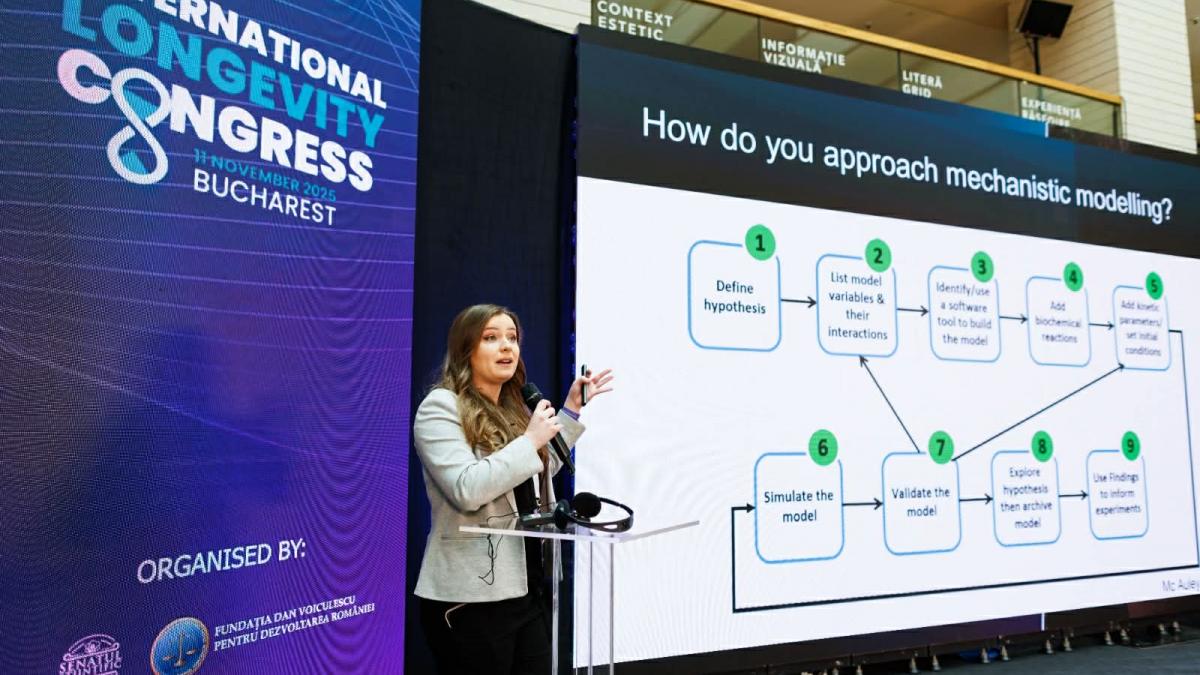

For the first time, Bucharest hosted a concrete discussion about how we can measure and even anticipate the way we age. British researcher Dr. Amy Morgan from the University of Salford, invited to the International Longevity Congress organized by the Scientific Senate of the Dan Voiculescu Foundation for the Development of Romania, introduced a technology that turns biology into predictive science: mathematical simulations of human aging.
„We can anticipate how the body changes over time, which biological systems deteriorate faster, and what we can do to protect them,” Dr. Morgan explained in her presentation. The researcher uses artificial intelligence models and computational biology to digitally recreate the main functions of the human body - metabolism, cardiovascular system, inflammation - and to observe how they evolve with age.
Her work gives doctors a window into the future. Through an extensive blood analysis containing hundreds of parameters, the algorithms can show which organ is aging faster and what interventions could prevent deterioration. „If we know early on that the heart or liver is biologically several years ahead of the rest of the body, we can intervene in a targeted way, not just generally. That’s what real prevention means,” she said.
One of the key points of her presentation was the direct link between inflammation, cholesterol, and cellular aging. Amy Morgan explained that chronic low-grade inflammation, often invisible in routine tests, accelerates cellular wear. „Dietary cholesterol isn’t the problem - saturated fats and the metabolic stress that triggers inflammatory reactions in the body are. That’s where many age-related diseases begin,” she emphasized.
The technology she is developing together with the University of Salford team integrates real data from clinical studies and transforms them into mathematical models. These simulations can be updated regularly so that doctors can track each patient’s biological rate of aging. Practically, medicine is entering a new stage: from reactive diagnosis to predictive monitoring.
Amy Morgan’s presentation was one of the most followed sessions at the congress. The researcher stressed that „longevity science is no longer just a laboratory dream, but a field with real-world applications,” and that new AI-based tools could become part of standard medical practice in the coming years.
The International Longevity Congress brought together ten specialists from the USA, UK, Sweden, Israel, and Germany. It was the first event in Southeast Europe dedicated to longevity science, organized in partnership with the International Longevity Alliance and supported by top research centers such as Karolinska Institutet, Harvard Medical School, and Yale University.
For the first time, Romania becomes part of the global dialogue on how we can live longer and healthier - and Dr. Amy Morgan’s presentation showed that aging can be calculated, understood, and, in time, controlled.