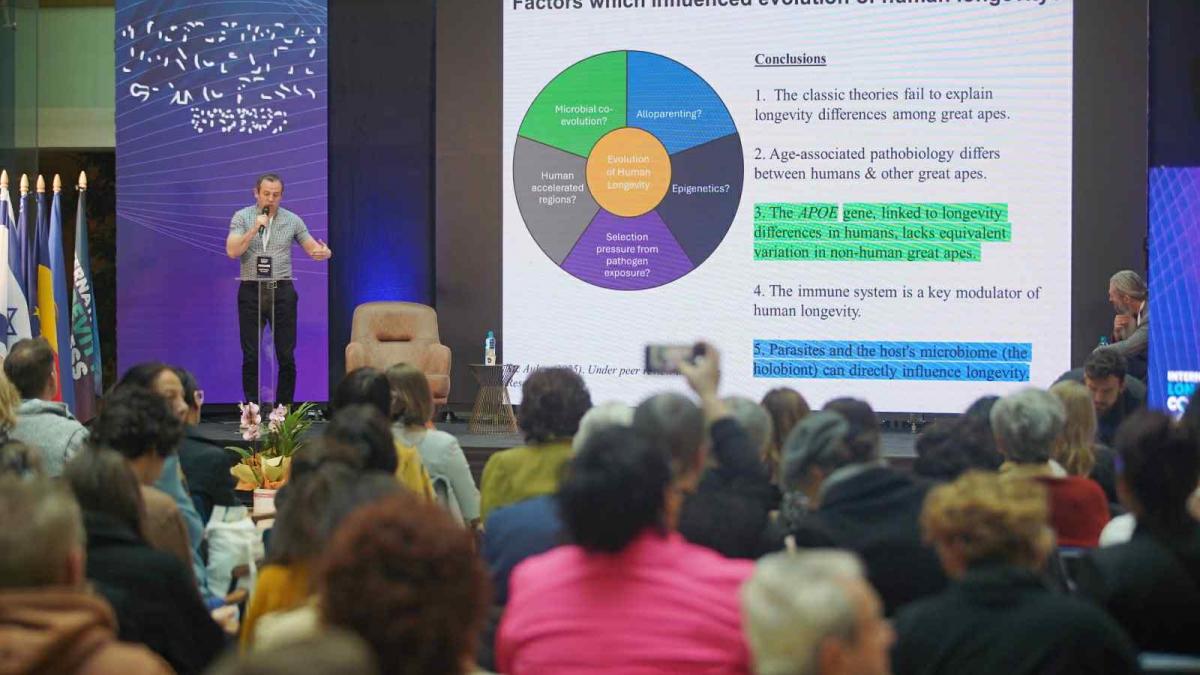

At the International Longevity Congress, organized by the Scientific Senate of the Dan Voiculescu Foundation for the Development of Romania, Irish researcher Mark Thomas McAuley captured the attention of the scientific community with a presentation that radically shifts the way we understand aging - not as a rigid, predetermined process, but as a far more flexible, malleable phenomenon that classical theories still fail to fully explain.
McAuley began by underscoring an often-ignored idea: aging is not simply the accumulation of damage or an inevitable decline. It is a profoundly plastic process, with major variations between species, populations, and even individuals. Because of this, he argues, traditional evolutionary theories cannot account for the full biological complexity observed in nature.
„Some organisms in nature completely defy the classical models. Their life-history strategies simply don’t fit the theories we’ve relied on for decades,” the researcher explained, emphasizing the need for a more flexible and interdisciplinary approach.
One of the most innovative aspects of McAuley’s work is his analysis of why humans live significantly longer than other primates. Among the key factors he identified: lipid metabolism, which appears to have evolved in humans in a way that favors extended lifespan; and the long-standing relationship with parasites and the microbiome, which has shaped both immunity and longevity across evolution.
„Our extended longevity is not accidental. The way we metabolize lipids and our historical relationship with parasites have profoundly shaped how we age,” he said.
Building on these insights, McAuley has developed a sophisticated computational model of cholesterol metabolism, which he is now expanding by integrating components of the immune system to better understand how chronic inflammation - the hallmark of aging - emerges.
A central part of his presentation focused on how epigenetic changes, particularly DNA methylation, influence the onset of age-related diseases. Unlike the widely used epigenetic „clocks,” McAuley’s team develops mechanistic models that reveal not just when changes occur, but how they arise over time.
„Maintenance methylation is the critical factor. If this mechanism becomes inaccurate, a cascade of changes is triggered - changes that can ultimately lead to disease,” he said, presenting mathematical analyses conducted with his doctoral students.
To bring these findings closer to clinical application, his team is working on an electrochemical biosensor capable of detecting extremely subtle methylation changes - technology that could, in the future, enable the early detection of age-related diseases years before symptoms appear.
In another line of research, McAuley is using mathematical modeling to evaluate how combined therapies might reduce the effects of cellular senescence - the biological „blockage” that accumulates with age and contributes to inflammation, degeneration, and fragility.
„There is no single solution. We need multiple interventions acting together on the mechanisms that drive aging,” he stressed.
For McAuley, aging cannot be reduced to one theory or a single cause. It is an emergent phenomenon resulting from the interaction of numerous processes - genetic, epigenetic, metabolic, immunological, and ecological.
„The biology of aging is a mosaic. If we want real progress, we must let go of rigid explanations and adopt a pluralistic, open perspective that brings together entire domains of science,” he said.
Mark Thomas McAuley’s presentation was one of the defining moments of the International Longevity Congress, marking an important step for Romania in the global dialogue about the future of anti-aging medicine and therapies aimed at preventing age-related diseases.